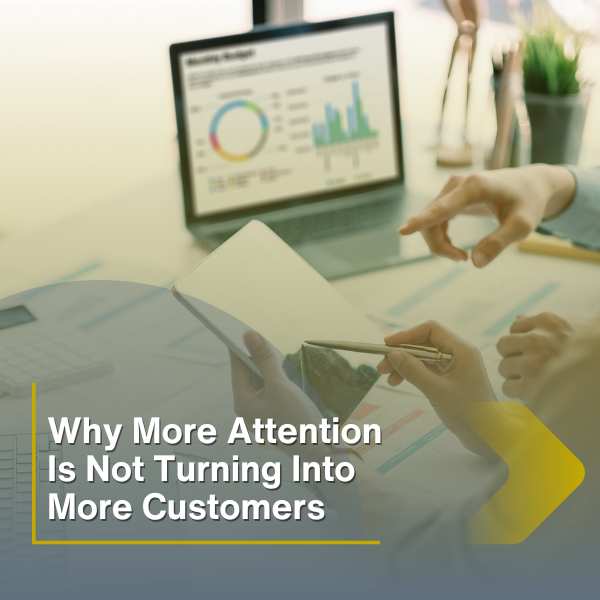
Why More Attention Is Not Turning Into More Customers
Your marketing report looks good. Traffic is up. Your video got a lot of views. Your LinkedIn post reached thousands of people.
So why doesn’t it feel like more customers are coming in?
Because attention and engagement aren’t the same thing. Attention gets you seen. Website engagement tells you whether your message is actually connecting.
Attention Is Only the First Step
Views, impressions, and visits tell you that people noticed you. That matters. You can’t win customers who never see you.
But noticing isn’t the same as caring. A visitor who lands on your website and leaves ten seconds later counted as traffic. A video viewer who scrolled past after three seconds counted as a view. Neither one moved any closer to becoming a customer.
When marketing is judged only on attention, it’s easy to celebrate numbers that don’t lead anywhere.
What Website Engagement Actually Looks Like
Engagement shows up in what people do after they notice you. Here are the signals worth paying attention to.
Time Spent
When someone spends several minutes on a page, they’re reading. They found something relevant enough to stay. That’s a very different visitor from someone who bounced immediately.
Clicks to the Next Step
Are visitors moving deeper into your site, from an article to a service page, or from a service page to your contact form? Movement shows interest.
Video Watch Time
A view counts at a few seconds. Watch time tells you whether people stayed for the message. If most viewers drop off early, the opening may not be connecting.
Replies and Responses
When people reply to your emails, comment thoughtfully on posts, or ask follow-up questions, your message landed.
Better Questions
This one is easy to miss. When prospects come to you already understanding the basics and asking about their specific situation, your marketing has done its job.
Qualified Inquiries
Ultimately, the best measure of engagement is inquiries from the kind of customers you actually want.
Why Engagement Matters More
Engagement tells you something traffic can’t: whether your message is relevant to the people seeing it.
If traffic is high and engagement is low, the problem may be the message, the audience, or the page. People are showing up, but something isn’t connecting. That’s valuable information, because it tells you what to fix.
If engagement is strong, even with modest traffic, you’re likely reaching the right people with the right message. That’s usually a better foundation for growth than a big number that goes nowhere.
How to Improve Engagement
Better engagement usually comes from being more specific and more useful:
- Speak to a specific customer. Generic messages are easy to ignore.
- Answer real questions. Content that helps people make decisions keeps them reading.
- Match the page to the message. When the destination continues the conversation, visitors stay.
- Make the next step obvious. Engagement grows when people know where to go.
Where to Start
Look at your most important service page and check three things: how long people stay, where they go next, and whether it produces the kind of inquiries you want.
Those answers will tell you more about your marketing than your total traffic ever could.
If your marketing is getting attention but not enough customers, Design Interventions can help you find where the connection is breaking down.